
The rise of AI has the capacity to remove much of the drudgery of marketing. But how good is it at storytelling?
At the Charge conference on energy branding, AI was on everyone’s mind. With data centers driving a monumental increase in energy demand, clean energy professionals are acutely aware of the need to power AI with renewable sources. But beyond the grid, there’s another question worth sitting with as marketers: What will AI do to the story of the energy transition itself?
At a workshop titled Cleantech Storytelling in the Age of AI: From Noise to Narrative, I joined a panel of marketing colleagues to explore how marketing teams are using AI today not just in their storytelling efforts but across the full marketing workflow, from ideation to performance analysis.
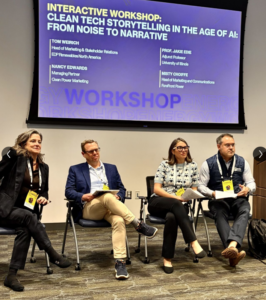
(L to R): Nancy Edwards, Clean Power Marketing; Jake Edie, RenewComm; Misty Chioffe, ForeFront Power; Tom Weirich, EDPR.
We asked participants about their use of AI and shared tips and tradeoffs of employing LLMs. Most people already rely on the tools’ extensive reporting capabilities, with many in the audience saying they use transcription not just for convenience but to analyze trend lines and identify usable quotes. Close behind: researching trends, finding relevant data points, developing reports, identifying gaps in story drafts, and increasingly, generating first drafts.
What AI Does Well
AI is fast. Claude, Chat and Perplexity draft original content with lightning speed. (Although this article is not being written by AI, I feel the pressure of AI like a task-master over my shoulder. How fast can I write this? Is this more original than Claude would generate?) A single well-crafted prompt can indeed generate a nearly “print”-ready piece that most people already cannot distinguish from its human-generated counterpart.
AI is actually a decent writer. LLM’s do a very good job (sometimes too good) at including every possible story point. You won’t find a grammatical error anywhere in AI content, as long as the words are being used literally. It’s not great at double entendres, but it does know syntax and is getting better at citation, so you can (and should) cite the original source for every data point.
AI is constantly learning. LLMs are getting better and smarter at telling our stories, because we’re training them with our own brains. AI’s ability to learn from our prompts and edits engenders in your AI tool a level of knowledge that even the most sage clean energy storytellers would be hard pressed to demonstrate.
But there are costs for this investment of our time, energy and yes, our creative brains.
Where AI falls short
AI makes mistakes. AI’s knowledge has a cut-off date, and it doesn’t know about breaking news. AI can hallucinate specific numbers, studies, or sources because the Internet is a replication machine. It doesn’t have access to your internal data or unpublished research, and while you can feed it information specific to your company, you should do so cautiously. The question of how AI systems use and store information remains unresolved.
AI hasn’t been in the room. It hasn’t walked the halls of a solar manufacturing facility, sat across from a customer, or navigated a deal. It can’t read a room, interpret nonverbal cues or understand subtle humor or office politics. LLMs can be tremendously helpful in culling through large reams of data, finding trends and crunching numbers. But they can’t replace human judgement and intuition, which drive a large majority of decisions, even in business.
AI is not great at branding or making creative leaps. While AI can help with aspects that go into good branding — competitive research for one – its understanding of the power of brand equity is limited. It can’t predict the human response to a brand story well told – or the intangible influence of a brand relationship in the decision-making process.
AI isn’t a great storyteller. Sure, it understands the dramatic arc – but does AI really satiate our ancient hunger for a good story? The use of descriptive details, the unexpected metaphor, the specific human moment that makes a piece land? AI’s creative output trends toward the safe and predictable — because it’s sourcing what’s already out there and repeating the same patterns. It simply recombines ideas, and won’t seek opinions outside its own echo chamber.

Detail from Michelangelo’s “Creation of Adam.” Even in the age of AI, the creative spark behind great storytelling remains deeply human.
As if to reinforce this point, when I asked Claude directly what it’s not good at, the response was disarmingly self-aware: “Claude works best as a skilled collaborator, not an autonomous expert. The sweet spot is pairing Claude’s speed and breadth with your domain expertise, judgment, and firsthand knowledge of your business and customers.”
The inspiration that infuses your brand with true originality? This is creative quicksilver — and still the territory of the human mind.
The real risk: losing the writer’s voice
AI’s greatest threat to storytelling isn’t that it produces bad content. It’s that it removes us from the creative struggle that makes us better. There’s something irreplaceable about being lost in the woods and having to find your own way out. That experience is where we develop our voices as writers.
As marketers, we know how important on-the-job experience is in developing our skills. If you looked back on your career, would you trade those hard-won moments for an AI-generated facsimile?
We are all wading into the waters of AI because the tools are just too good to ignore. But as you do so, tread thoughtfully. Use AI for the parts of your job that drain you. Save the story for yourself.
By Nancy Edwards, Managing Partner, Clean Power Marketing